Context
Brands spend heavily before a launch and learn how it landed only afterwards, when the reviews arrive. In between, people talk about the product online. Marketing research has used that pre-launch word of mouth before (Houston et al., 2018; Tirunillai & Tellis, 2014), mostly with topic models such as LDA that capture what is discussed, not how.
The question
Do measurable signals in pre-launch conversation predict the sentiment of post-launch reviews? And does the answer differ for products bought for pleasure (hedonic) and products bought for a job (utilitarian)?
Approach
-
Data. Pre-launch posts and comments from Reddit, collected through the API with PRAW. Post-launch reviews from Amazon. Search-interest controls from Google Trends (pytrends).
-
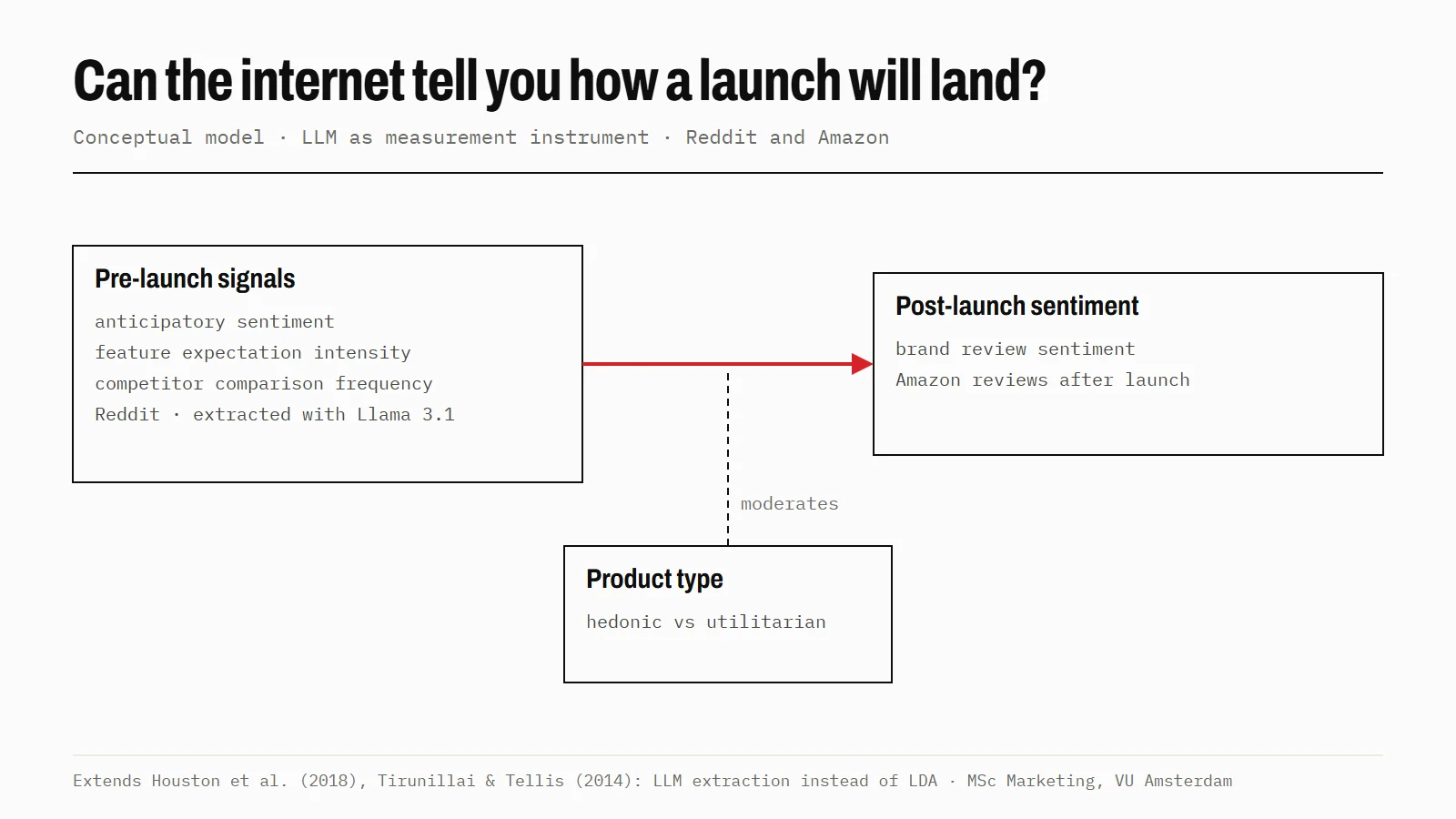
Measurement. An open-source LLM (Llama 3.1) reads each post and extracts three signals:
- anticipatory sentiment: how people feel about the coming product;
- feature expectation intensity: how strongly they expect specific features;
- competitor comparison frequency: how often the product is set against rivals.
The LLM is the measurement instrument here, not the product. Its outputs are checked like any other measure.
-
Model. Regression of post-launch brand review sentiment on the three signals, with product type (hedonic or utilitarian) as a moderator.
Why it matters outside academia
- For brand and launch managers: a monitoring framework that flags a launch at risk while there is still time to adjust the message or the product.
- For consultants: a replicable method (an extraction pipeline plus a predictive model) that turns into a launch-readiness assessment for clients.
- For analysts: a general recipe for pulling structured, predictive variables out of unstructured text ahead of an event.
Status and limits
The research design, data pipeline and models are built. The written thesis is what gets examined. Text from Reddit and Amazon is not a representative sample of buyers, LLM extraction needs validation against human coding, and the results apply to the product categories studied.