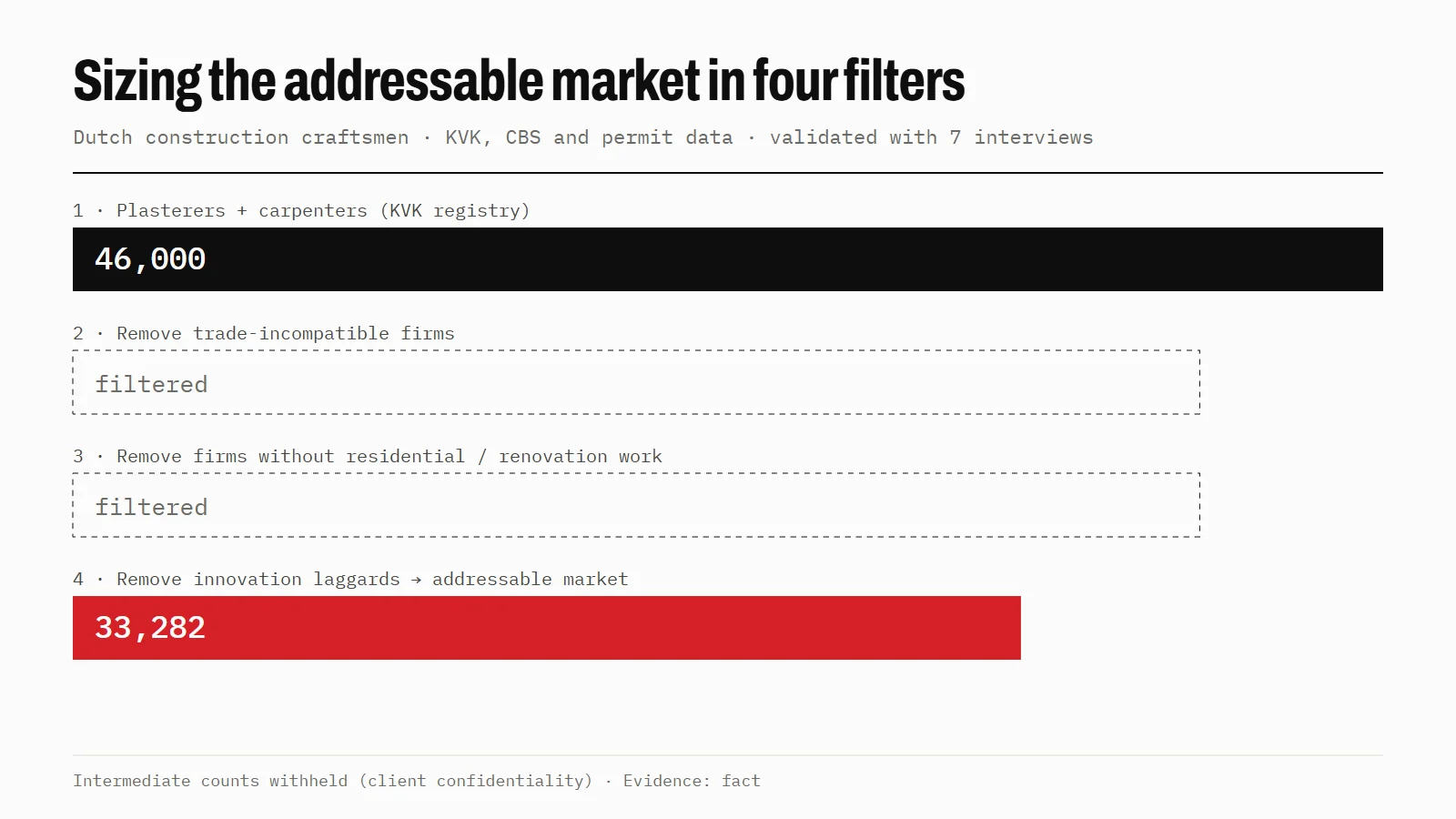
- 46,000plasterers and carpenters in the KVK registry
- 33,282addressable firms after four filters
- 7in-depth interviews with Dutch craftsmen
- 7/7had never heard of the brand
Context
ClayTec makes clay plasters, clay boards and natural wall finishes in Germany. It wanted more Dutch craftsmen using them. I ran the project as a consulting engagement from October to December 2025: one researcher, a real company and a deliverable a sales team could act on.
The question
Is there a market worth entering, how big is it, and which craftsmen should ClayTec win first?
Approach
Sizing. I built a four-stage funnel from public data: KVK registry codes, CBS statistics on construction workers, and building permits across the twelve provinces.
- All plasterers and carpenters in the KVK registry: about 46,000 firms.
- Remove trade-incompatible firms (industrial, B2B-only).
- Remove firms without residential or renovation work.
- Remove the late-adopter tail, using published innovation-adoption rates.
That leaves 33,282 addressable firms.
Segmentation. Four segments, named after how they decide:
- Practical Builders, the largest group: they follow what clients ask for and what peers recommend.
- Traditionalists: loyal to proven brands, hard to win, hard to lose.
- Eco-Driven Specialists: small, already open to clay, valuable as references.
- Industrial Contractors: excluded, because the product and buying process don’t fit.
Validation. Seven in-depth interviews with plasterers and carpenters around Amsterdam and South Holland, all using the same guide (background, purchasing, sustainability, brand awareness, outlook). I then mapped a five-stage journey (awareness, consideration, purchase, retention, advocacy) for the two main segments.
What I found
- Zero awareness. None of the seven had heard of ClayTec.
- Word of mouth runs the market. Craftsmen find both clients and materials through peers.
- Availability beats everything. If it isn’t at a merchant within about 30 km, it doesn’t exist.
- Sustainability is client-led. Craftsmen adopt eco materials when clients ask. Around a quarter of their clients now mention it, up from almost none five years ago.
- Price is the first objection, and it usually comes from the client, not the craftsman. Clay can cost about twice as much as the conventional option.
Recommendation
A phased entry, led by distribution:
- 0–6 months. Partner with 5–10 regional merchants in North and South Holland. Produce Dutch-language application videos. Run an early-adopter programme with 50 Practical Builder projects.
- 6–12 months. Hands-on workshops in Amsterdam and Rotterdam, 20–30 documented projects, and 15–20 merchants.
- 12–24 months. A proof programme with performance guarantees for Traditionalists, an architect spec-in programme, and craftsman referrals.
Sequence: Practical Builders for volume, Eco-Driven Specialists for proof, Traditionalists for scale.
Limits
Seven interviews show direction, not statistical proof. Segment sizes rest on proxy variables (registry codes, regional permit shares, adoption rates), and I documented each assumption so the sizing can be updated. Per-segment counts and pricing findings are left out here because they are confidential.