- 16EA game launches, 2017–2018
- −0.177log-sales per week after launch (p < 0.001)
- 2.6×teaser effect vs trailer (β 0.259 vs 0.098)
- ~20paid tweets a week before returns diminish
Context
The brief came from a fictional small publisher, ABA Games, that wanted to learn from Electronic Arts before planning its own launch. There were two datasets: daily media and buzz data, and weekly sales, across 16 EA launches in 2017 and 2018.
The question
- What drives game sales?
- What drives online buzz?
- What should a smaller publisher do with that?
Approach
- Data work. Aggregated the daily data to weeks so it could be merged with sales. Cut the panel at the first launch. Built launch windows per game. Dummy-coded overlapping launches instead of dropping them.
- Buzz. A composite of Reddit volume, Reddit sentiment and news volume.
- Models. Game fixed effects throughout, to absorb franchise strength, with HC3 robust standard errors. Log-sales on buzz, weeks-to-launch and seasonality. Buzz on owned media, paid volume and its square (to catch diminishing returns), news, trailers, teasers, press releases, conventions and lagged buzz.
What I found
- Sales decay fast. About −0.177 log-sales per week after launch (p < 0.001). The first five weeks decide the result.
- Buzz did not predict sales (p = 0.87). I report this rather than hide it: buzz and sales are likely determined together (Duan et al., 2008), and weekly aggregation blurs the link.
- Franchise strength dominates. FIFA and Battlefield carry the largest fixed effects; NHL is negative.
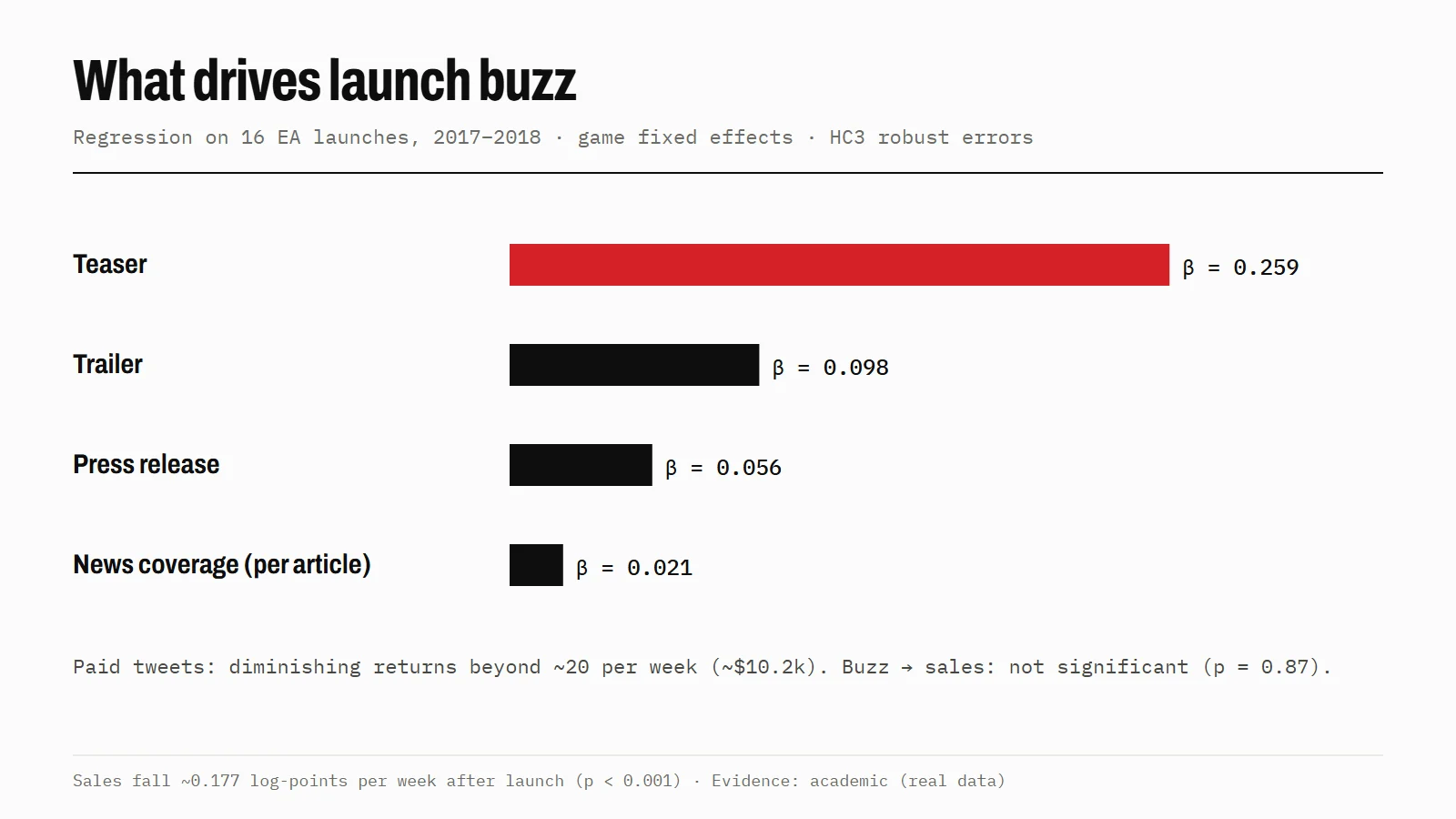
- What creates buzz: news coverage (β = 0.021, p < 0.001), teasers (β = 0.259) well ahead of trailers (β = 0.098), and press releases (β = 0.056, p = 0.002). Paid tweet volume alone is not significant, but its squared term shows diminishing returns.
- Timing: buzz peaks 16 to 20 days after a trailer, at about six times baseline, with a half-life of about 17 days.
Recommendation
- Front-load the budget around launch. Spend after launch has little left to win.
- Cap paid tweets near 20 a week (about $10,200 at EA scale). A smaller publisher with a smaller network will hit that ceiling sooner.
- Release the trailer about 2.5 weeks before launch, paired with a paid push, so the buzz peak lands on launch week.
Limits
These results are observational, from one publisher and two years. The null result on buzz and sales is a measurement and identification problem, not proof that buzz doesn’t matter. Convention effects are biased by several games competing in the same week.